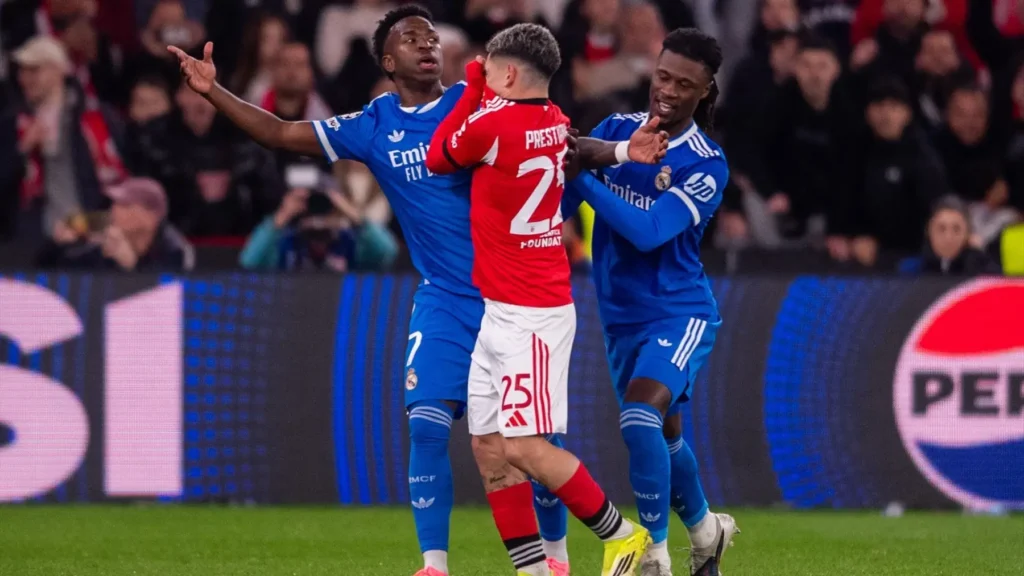
UEFA’s call not to adopt the so-called Vinicius law for its own competitions is more than a refereeing footnote for Real Madrid. It reopens one of the club’s ugliest storylines from last season and leaves Vinicius Jr. without the same on-field protection FIFA chose to use at the 2026 World Cup.
The issue matters because the whole debate grew out of a Champions League night involving Real Madrid. In February, the referee in Benfica vs. Real Madrid activated the anti-racism protocol after Vinicius reported receiving a racist insult from Benfica player Gianluca Prestianni, and Madrid later said it submitted all available evidence to UEFA while the governing body opened an investigation.
Why the UEFA Vinicius law decision matters to Real Madrid
What Spanish media have called the Vinicius law is the World Cup-era rule allowing a red card for a player who covers his mouth during a confrontation with an opponent. FIFA explained that IFAB unanimously approved the measure in April, with the rule to be used at the competition organizer’s discretion and implemented at the 2026 World Cup. FIFA said the purpose was to address discriminatory and inappropriate behavior, especially when players try to hide what they are saying.
That point is central to why Real Madrid care. The complaint around the Vinicius-Prestianni incident was not only what may have been said, but how it was allegedly concealed. AP reported that FIFA pushed the rule after the Prestianni-Vinicius controversy and that the aim was to stop players from hiding abusive, discriminatory, or offensive language on the field by covering their mouths.
In practical terms, FIFA have already shown they are willing to enforce it. AP reported that Paraguay’s Miguel Almirón and Ecuador’s Piero Hincapié were both sent off at the World Cup under the new rule, which made the measure feel less theoretical and more like a serious deterrent. That is exactly the part Real Madrid and Vinicius would have wanted to see carried into Europe.
UEFA Vinicius law refusal shows a clear split with FIFA
UEFA, though, has gone another way. AS reported that UEFA confirmed the rule would not be used in the Champions League, Europa League, or Conference League, even as FIFA applied it at the World Cup. The same AS report said UEFA’s objection during the discussions was that the measure would threaten the freedom of expression of footballers.
That is the line OKDIARIO seized on, and it is easy to see why the reaction has been so strong around Real Madrid. From the club’s point of view, this debate is not abstract. It grew out of a case where Vinicius said he was insulted, the match had to be stopped under the anti-racism protocol, and Madrid formally escalated the issue to UEFA afterward. When UEFA then declines to use the stronger World Cup deterrent in its own tournaments, Madrid supporters are always going to read that as a step backward rather than a technical policy choice.
There is also a larger credibility problem here. FIFA and IFAB effectively decided that mouth-covering in confrontations can be serious enough to justify an immediate dismissal, at least if a competition organizer wants to use that tool. UEFA are entitled to reject that approach, because FIFA’s own text makes the rule optional rather than mandatory. But once Europe says no, it also accepts that its competitions will be judged against a more lenient standard than the World Cup on one of the sport’s most sensitive issues.
What this means for Real Madrid and Vinicius
For Real Madrid, the problem is not just that UEFA disagrees with FIFA. It is that the disagreement lands in the exact area where Madrid have already felt exposed. The club publicly backed Vinicius after the Benfica incident, thanked the football world for its support, and said it would continue working with institutions to eradicate racism, violence, and hate in sport. UEFA’s decision does not erase that support, but it does mean Madrid return to the same European environment without the extra on-field sanction FIFA chose to introduce.
There is an argument, of course, that UEFA are trying to avoid automatic punishments in situations where context can be hard to judge in real time. But that is also exactly why Madrid and Vinicius wanted a tougher rule in the first place. If a player hides his mouth during a confrontation, the act itself can prevent cameras, referees, and even opponents from proving what was said. FIFA’s answer was to punish the concealment. UEFA’s answer is to keep relying on the older framework.
That distinction matters because it changes who carries the burden. Under the World Cup approach, the player who tries to hide a confrontation risks immediate sanction. Under UEFA’s approach, the burden shifts back toward proving the abuse after the fact, in situations where concealment may have been the whole point. From a Real Madrid angle, that is the clearest reason this story feels like more than administrative news. It affects how protected Vinicius is likely to feel on European nights.
Why this matters beyond one player
This is also a wider club issue, not only a Vinicius issue. Real Madrid have spent years positioning themselves as one of the loudest elite clubs against racist abuse directed at their players, and the February statement showed the club were willing to escalate matters institutionally, not just emotionally. A UEFA Vinicius law refusal therefore cuts against the direction Madrid have tried to push the sport.
It is the kind of topic that should keep readers moving across the site too, because it connects naturally to bigger questions: how Real Madrid will respond the next time there is a similar controversy in Europe, whether UEFA’s stance changes if more incidents pile up, and how much pressure Vinicius and Madrid can still exert on football’s institutions from the outside.
Conclusion
The UEFA Vinicius law decision does not mean Europe is indifferent to abuse. It does mean UEFA and FIFA now have visibly different answers to the same problem. FIFA chose an immediate deterrent for the World Cup. UEFA chose not to follow it in its own competitions, citing freedom-of-expression concerns. For Real Madrid, that leaves an uncomfortable conclusion: the competition where this debate exploded is also the one least willing to copy the strongest response to it.
Sources Used:


More Stories
Yan Diomande Real Madrid Debut Delayed as Mourinho Leaves Winger Out
Ferencvaros vs Real Madrid: Mourinho Starts Endrick as Bernardo Silva Waits
Rodri Real Madrid Transfer Collapses as Barcelona Wins Player’s Choice