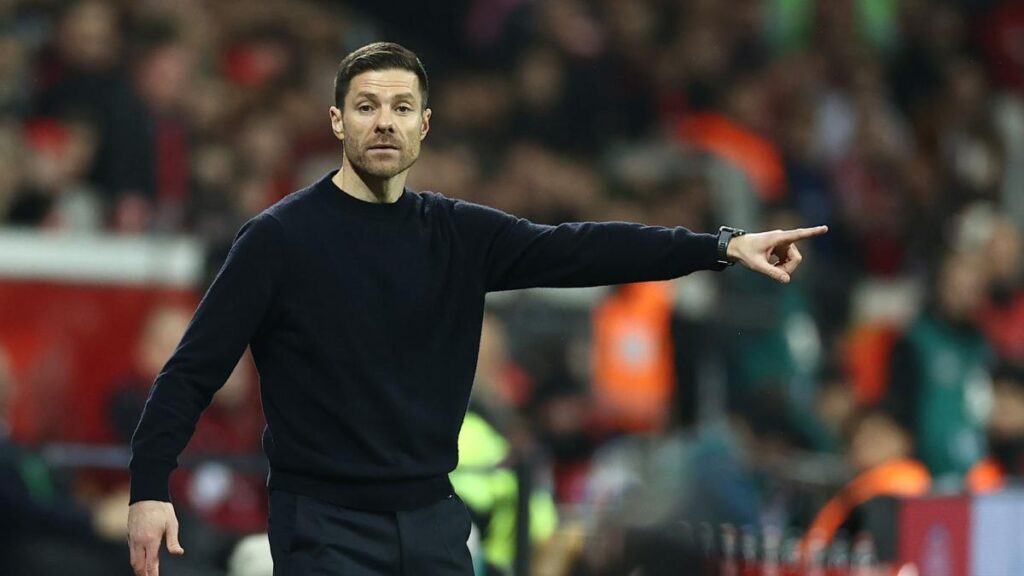
Dek: Madrid kept control but rarely destabilized Rayo’s compact 4-4-2. Valverde at RB, Asencio–Huijsen at CB and Brahim in the XI shaped the build-up, yet shot quality and occupation of the box lagged. [1][2][3]
Key Tactical Takeaways
- Madrid’s base: a 2-3 / 3-2 build with Valverde tucking in and Carreras pushing high; Brahim operated as the right-sided connector. Territory was fine, chance quality wasn’t (xG 0.82 to Rayo’s 1.19). [3]
- Rayo’s plan: mid-block 4-4-2 morphing to 4-5-1, heavy touchline traps and quick diagonals to Álvaro/Isi. They limited Mbappé to scraps and lived off counters and second balls. [1][5]
- Final-third issue: poor box occupation and slow rotations on the right; many shots but few telling ones (shots 21–13 for Madrid, SOG 5–2, yet low xG). [2][3]
- Adjustments: Militao for Huijsen, later Ceballos and Rodrygo to add runners; Trent for Valverde late. None changed the spacing problem around Bellingham/Mbappé. [3]
- Context: Two dropped points but defensive stability held; Alonso stressed perspective post-match. [4]
Tactical Essentials
- Base shapes (RMA): 4-3-3 on paper → 2-3 in build (Asencio–Huijsen; Carreras high, Valverde in), sometimes 3-2 when Valverde stayed wide and Camavinga dropped. Out of possession: 4-1-4-1 with Güler alongside Bellingham pressing inside lanes. [3]
- Rayo: 4-4-2 mid-block → 4-5-1 near area; Isi/Álvaro sprung counters into the channels. [1][5]
- Key subs (mins): 46’ Militao ↔ Huijsen; 71’ Ceballos ↔ Brahim; 83’ Rodrygo ↔ Camavinga; 83’ Trent ↔ Valverde. [3]
- Metrics: Possession ~54% RMA, shots 21–13, SOG 5–2, big chances 1–2; xG 0.82–1.19 (RMA–RAY). [2][3]
- Ref: Juan Martínez Munuera. Result: Rayo 0–0 Real Madrid. [2][3]
Analysis & Tactics — Deep Dive
Shapes & Roles
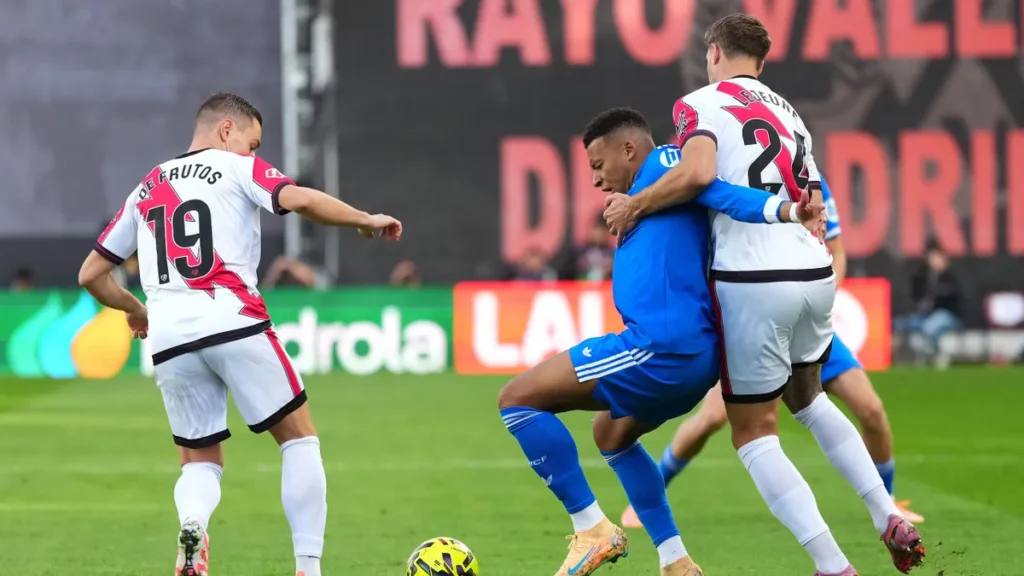
Alonso kept the recent improvisation at the back: Valverde nominally at right-back but sliding into midfield in the first phase; Carreras advanced on the left to pin Rayo’s wide man; Asencio–Huijsen as a measured-plus-aggressive CB duo. The midfield triangle flipped often: Camavinga as single pivot with Güler deeper right-half space and Bellingham higher as the third-man runner. Up front, Brahim–Mbappé–Vinícius offered mobility but little aerial presence.
Rayo’s 4-4-2 lines stayed compact. The near-side winger (usually Álvaro García) jumped to Valverde/Carreras on triggers; the nine (Isi) curved the press to shade passes into Camavinga. The far winger tucked to protect the half-space: classic Vallecas mid-block. [1][5]
Build-up & Pressing
Madrid’s first phase was calm: Courtois → Asencio/Huijsen → Valverde inside = a 2-3 rest-shape. The idea: draw out Rayo’s first line, find Güler between lines, then switch to the far-side runner (Carreras or Vinícius). It produced volume, not clarity: Rayo’s angled pressure kept passes along the U-shape and forced early crosses or conservative recycling. [1][3]
Out of possession, Madrid’s press was selective. Bellingham led a curved run to the goalkeeper; Brahim jumped to the full-back; Güler stepped onto Pedro Díaz/Unai López. When Rayo went long, Asencio’s cover was fine but second-ball protection behind Carreras suffered, inviting transitions. The numbers back the story: Rayo generated two big chances despite fewer total shots. [3]
Progression & Creation
Madrid’s right side never truly clicked. Brahim frequently received to feet but lacked the immediate underlap/overlap to unbalance Pep Chavarría. With Valverde oscillating between touchline support and interior pivot, the lane rotations (Brahim inside, Güler wide; or Güler inside, Valverde overlap) were too slow. The consequence: arrivals into the box were one or two bodies short, so cut-backs found no second wave. xG reflects it (0.82 on 21 attempts). [2][3]
On the left, Vinícius met a narrow Rayo back four. Carreras’ height stretched the last line, but Mbappé often dropped to combine rather than threaten depth between CB and LB. Without a consistent pin on the last shoulder, Rayo’s line squeezed up and collapsed the half-spaces where Bellingham thrives. When Bellingham finally attacked the near-post zone in stoppage time, his header went wide — emblematic of late, rushed occupation rather than rehearsed patterns. [2]
Transitions & Rest-Defense
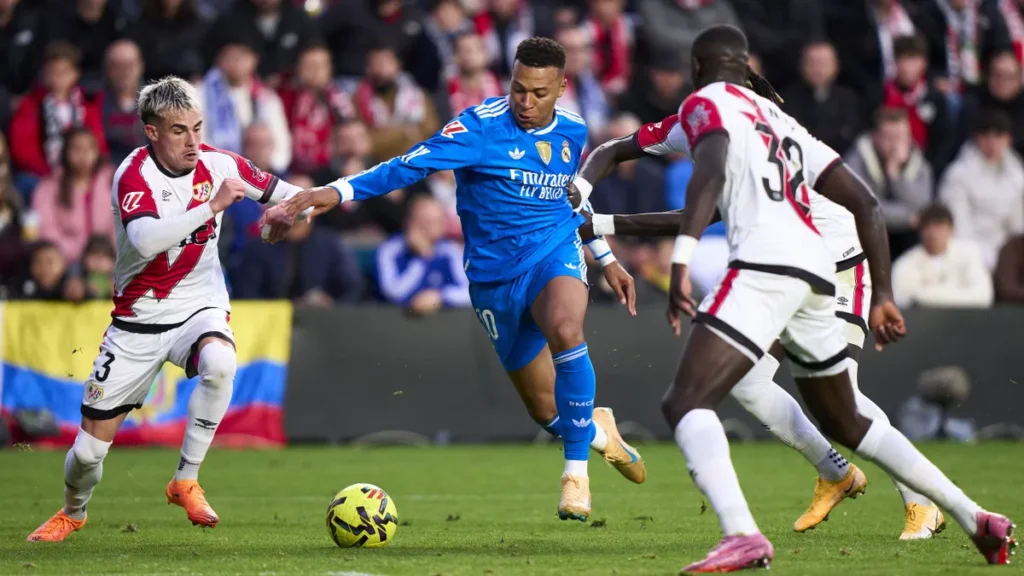
Madrid’s counter-press was mixed. First contacts were decent, but the distance from Camavinga to the CBs during wide attacks left a lane for Rayo to escape. De Frutos and Álvaro carried direct diagonals into space behind Carreras, where Asencio had to delay and wait for help. That trade-off — maxing width with Carreras high vs. protecting counters — is where Rayo found their best looks, reflected in the xG edge and two big chances. [3][5]
Conversely, when Madrid broke, Mbappé’s isolation was obvious: Rayo’s near-side full-back fouled early or delayed enough for the narrow block to reset. Without Tchouaméni’s long diagonal outlet or Carvajal’s blind-side overlap, Madrid’s release valves were predictable.
Adjustments
- 46’ Militao for Huijsen: aimed at better duel winning + recovery pace for transition cover. It stabilized the back line but didn’t fix progression. [3]
- 71’ Ceballos for Brahim: more possession control and late box arrivals from an interior role; Madrid gained touches, not incision. [3]
- 83’ Rodrygo for Camavinga with Güler deeper: a gamble for 2-1-4-3 shapes in possession. It improved occupation but crowded the same channels — Rayo’s block simply sank five. [3]
- 83’ Trent for Valverde: a pure crossing threat and underlap service. Cross volume rose; shot quality didn’t. [3]
Overall, Alonso’s tweaks targeted speed of circulation and extra runners, yet Rayo’s discipline and goalkeeper Batalla (key saves, strong claims) preserved parity. [1][5]
Set-Plays
Madrid leaned on outswing corners to the penalty spot for Bellingham/Militao. Rayo countered with zonal across the six plus a spare on Bellingham. One of Madrid’s best looks came from a late corner (Bellingham header wide). Rayo’s own dead balls targeted Lejeune vs. Asencio; Courtois commanded well. [2][3]
Standout Individuals
- Valverde (RB/Captain): diligent hybrid role, but the team lacked a true overlap threat on his flank until Trent’s entry.
- Güler: best progressive passer between lines; several clean receptions but limited final action as lanes shut.
- Bellingham: influence grew late; still, his timed arrivals weren’t matched by service.
- Batalla (Rayo): decisive handling and reflex stops under traffic; the game’s most influential player defensively. [1][2]
- Álvaro García (Rayo): constant outlet into Carreras’ back shoulder, key to Rayo’s counter-punches. [5]
What It Means
Madrid retain control of the title race but leave the door ajar; Barcelona can cut the gap with their result. The performance highlights two short-term tasks:
- Right-side automation — cleaner, faster rotations among Valverde/Trent, Güler and the right winger to create true 2v1s.
- Box occupation — ensure three in the area on wide attacks (near-post, penalty spot, far-post), with Bellingham’s timing coordinated with Mbappé/Vini.
Alonso’s post-match message was measured — it’s still early and the defensive base is solid — but the attacking structure needs sharper choreography when opponents sit in a compact mid-block. [4]
FAQs
What were the most telling numbers?
Madrid led shots 21–13 and possession ~54%, but xG 0.82–1.19 and big chances 1–2 reveal why it finished 0–0. [2][3]
Why didn’t Mbappé get joy in behind?
Rayo’s line squeezed up, the wingers tracked back, and Madrid didn’t consistently pin the last line with a depth runner — Mbappé often dropped to link. [1][3]
Did the subs improve Madrid?
They improved control and width, not chance quality. The spacing around the No.9 zone remained under-occupied. [3]
References
[1] Reuters: “Spirited Rayo Vallecano hold Real Madrid to 0-0 draw.” Published Nov 9, 2025. Reuters
[2] ESPN Match Center: “Rayo vs. Real Madrid — live score & stats.” ESPN.com
[3] FotMob (Opta): “Rayo Vallecano vs Real Madrid — stats, xG, events.” FotMob+1
[4] Managing Madrid: “Xabi Alonso: ‘We’re still in November…’ (post-match).” Managing Madrid
[5] AS USA: “Rayo Vallecano vs Real Madrid summary: 0-0, updates and context.” AS USA


More Stories
Real Madrid TV penalty controversy grows after 245 replays of Betis handball appeal
Alvaro Arbeloa refereeing rant adds to Real Madrid frustration after Betis draw
Real Madrid title hopes take major hit after late Real Betis collapse