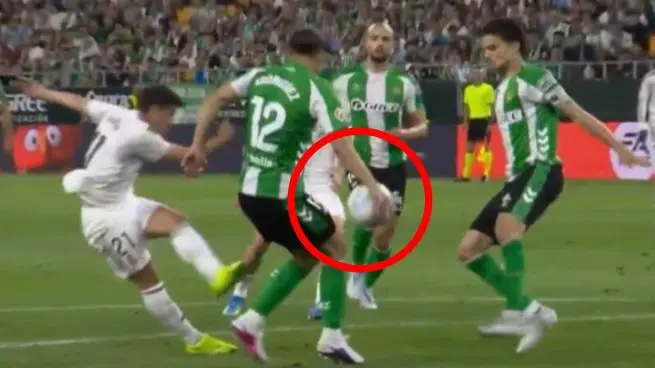
The Real Madrid TV penalty controversy has become one of the biggest talking points to come out of Madrid’s 1-1 draw with Real Betis, and not only because of the decision itself. According to Mundo Deportivo, the club’s official channel replayed Madrid’s first-half handball appeal against Betis defender Ricardo Rodríguez 245 times during its post-match coverage, turning one disputed moment into the emotional center of the night.
That reaction did not happen in a vacuum. Madrid dropped two more points in Seville after Héctor Bellerín’s late equalizer, and the result left the team even further behind Barcelona in the title race. ESPN’s updated standings show Barcelona on 85 points and Real Madrid on 74 after 33 matches, which explains why every controversial call now feels magnified around the club.
Why the Real Madrid TV penalty controversy blew up after Betis
The incident at the center of the storm came in the 23rd minute, when Brahim Díaz’s shot struck Ricardo Rodríguez inside the Betis area. Referee César Soto Grado did not award a penalty, and according to Mundo Deportivo, VAR official Pablo González Fuertes also did not intervene because the action was judged non-punishable. Madrid’s official television coverage made that play the entire narrative of the night.
Mundo Deportivo reported that Real Madrid TV’s post-match program repeatedly looped the same sequence from multiple angles and even warned viewers they would keep seeing the incident. The reported total of 245 replays is what pushed this from normal post-match frustration into a genuine media story. Complaints about officiating are common in elite football. Building an entire broadcast around one moment to that extent is not.
The channel’s tone also mattered. Mundo Deportivo said the broadcast did not limit itself to the single handball call, but broadened its criticism to the refereeing structure, LaLiga president Javier Tebas, RFEF president Rafael Louzán, Barcelona in relation to the Negreira case, and even parts of the media. That made the night feel less like a standard club reaction and more like another chapter in a wider communication strategy that Madrid supporters have seen before from the club’s in-house platform.
The play that fueled everything
There is no question why Madrid were angry about the call. From the club’s perspective, it was the kind of incident that can swing a title race when margins are already razor-thin. Mundo Deportivo also reported that head coach Álvaro Arbeloa described the action as a “clear penalty” in his post-match comments, reinforcing the sense that the team believed it had been denied a major decision.
But the full match context matters too. Reuters reported that Madrid led through Vinícius Júnior in the 17th minute, created chances to put the game away, and still conceded deep into stoppage time when Bellerín struck after Betis forced panic in the Madrid area. That does not erase the handball complaint, but it does show why this draw cannot be explained only through refereeing. Madrid had openings to control the match and failed to take them.
Why the second handball appeal matters
One detail makes this story more complicated than a single grievance. ESPN noted that both sides had reason to feel fortunate on penalty decisions, reporting that Brahim Díaz was lucky to avoid conceding for a possible handball while Rodríguez also appeared to handle for Betis. That broader context is important because it undercuts the idea that only one team left Seville feeling hard done by.
That does not mean Madrid fans have to agree with the officials’ judgment. It does mean the conversation should stay bigger than one freeze frame. The emotional energy around the Real Madrid TV penalty controversy says a lot about the state of the title race, but it also says something about a team that is increasingly living on edge late in the season.
What this means for Real Madrid
The most revealing part of this story may be what happened after the final whistle, not during the 90 minutes. When a dropped result turns into a televised campaign around one call, it suggests the club environment is operating under intense pressure. Madrid are not only fighting opponents anymore; they are fighting the weight of a season that now feels close to slipping away in LaLiga.
That is why this moment matters beyond the immediate outrage. Great Madrid sides usually impose the conversation through football. Right now, too much of the discussion is being driven by reaction, frustration, and refereeing narratives. The team still has enough quality to finish strongly, but the balance between competitive fire and institutional distraction is becoming harder to ignore.
It also opens up several bigger themes Real Madrid readers will want to keep tracking over the coming days: how Arbeloa manages the emotional fallout, whether Madrid can reset mentally after such a damaging draw, and what this sequence says about the club’s wider direction heading into the summer. This was one result, but it touches squad mentality, messaging, and the pressure surrounding every major decision.
What happens next
The Real Madrid TV penalty controversy is unlikely to disappear quickly because it fits an established pattern in how the club channel responds to officiating disputes. But the harder truth for Madrid is that broadcasts do not recover points. The only way to change the mood now is on the field, where missed chances, late-game management, and the emotional control of the group will matter just as much as any refereeing decision.
In the end, the biggest question is not whether Madrid had a case for a penalty at Betis. It is whether the club wants this phase of the season to be defined by grievance or by response. For now, the Real Madrid TV penalty controversy feels like the clearest symbol of a side under pressure, chasing answers as fast as it is chasing points.
Sources Used:




More Stories
Alvaro Arbeloa refereeing rant adds to Real Madrid frustration after Betis draw
Real Madrid title hopes take major hit after late Real Betis collapse
Real Madrid vs Real Betis match reaction: Vinícius and Lunin deserved more than a point