Dek:
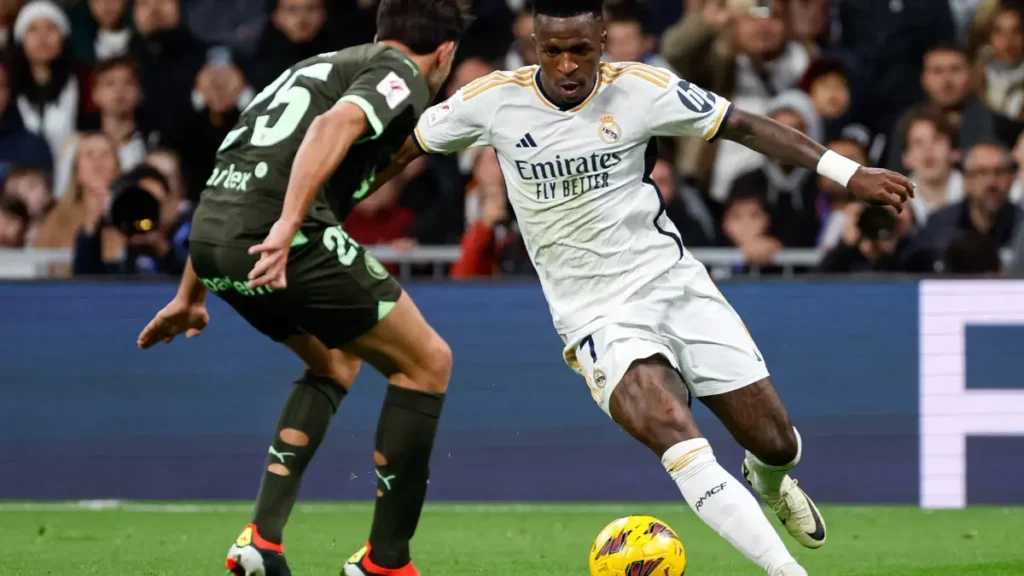
In a La Liga title showdown on 10 February 2024, Real Madrid crushed surprise challengers Girona 4–0 at the Bernabéu. This is the full tactical breakdown of how Carlo Ancelotti’s patched-up back line produced one of the most dominant displays of the season.
Key Tactical Takeaways
- Makeshift back line, elite control: With no fit senior centre-backs, Ancelotti used Aurélien Tchouaméni and Dani Carvajal at CB – and still held Girona to just 0.18 xG and zero shots on target. [3][6] understat.com+1
- Asymmetrical 4-3-1-2: Madrid’s 4-3-1-2 morphed into a left-leaning 3-2-5 in possession, with Ferland Mendy tucking in, Lucas Vázquez providing width, and Jude Bellingham roaming as a free 10. [3][6][7] understat.com+2Managing Madrid+2
- Vinícius as primary disruptor: Vinícius Júnior’s early goal and constant targeting of Yan Couto tilted the game; he directly contributed to three goals and repeatedly ripped open Girona’s right side. [2][5] Reuters+1
- Central lockdown against La Liga’s hottest attack: Girona arrived as prolific co-leaders; Madrid’s compact mid-block shut down the Aleix García–Dovbyk axis and forced low-value wide shots. [2][4][6] Reuters+2FootballCritic+2
- Title-race statement: The 4–0 win opened a five-point gap at the top and effectively punctured Girona’s title push while confirming Madrid as clear favourites. [1][2][5]
Tactical Essentials
- Match: Real Madrid 4–0 Girona, La Liga 2023–24
- Date & time: 10 February 2024, 17:30 (Madrid, CET / UTC+1) ESPN.com
- Venue: Estadio Santiago Bernabéu, Madrid – attendance ~76,585 [1] ESPN.com
- Scoreline & scorers:
- 1–0 Vinícius Júnior 5′
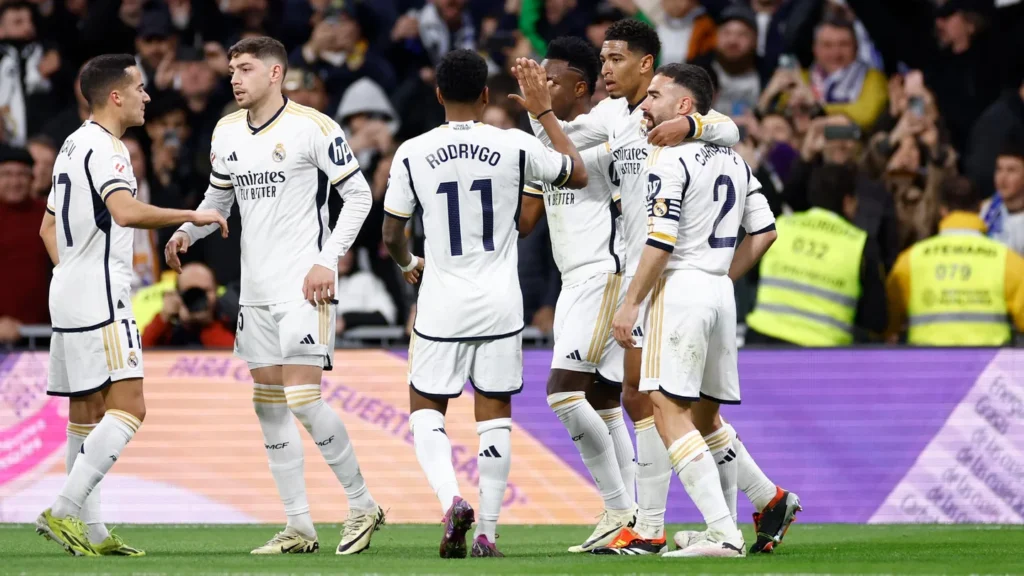
- 2–0 Jude Bellingham 34′
- 3–0 Jude Bellingham 53′
- 4–0 Rodrygo 61′ [3][5] understat.com+1
- xG: Real Madrid 3.33 – 0.18 Girona understat.com
- Shots: Real Madrid 16 (6 on target) – Girona 5 (0 on target) [3][4] understat.com+1
- Possession: Approx. 53% Real Madrid – 47% Girona [4] FootballCritic
- PPDA (pressing intensity): Real Madrid 30.2; Girona 21.0 – highlighting Madrid’s controlled mid-block vs Girona’s more proactive press. [3] understat.com
- Referee: Juan Martínez Munuera [1] ESPN.com
Formations (nominal):
- Real Madrid: 4-3-1-2
- Lunin; Vázquez, Carvajal, Tchouaméni, Mendy; Valverde, Kroos, Camavinga; Bellingham; Rodrygo, Vinícius. [3][4] understat.com+1
- Girona: 4-2-3-1
- Gazzaniga; Yan Couto, Eric García, Juanpe, Miguel Gutiérrez; Aleix García, Iván Martín; Tsygankov, Portu, Sávio; Dovbyk. [3] understat.com
Key subs: Brahim for Bellingham (61′, after ankle knock), Fran García for Mendy, Arda Güler for Vini, Joselu for Rodrygo; triple attacking refresh after the hour. [3][5][20]
Analysis & Tactics — Deep Dive
Shapes & Roles
Real Madrid without centre-backs could have been a chaos game. Instead, Ancelotti built a structure that masked the absences:
- Out of possession, Madrid looked like a 4-3-1-2, with Bellingham joining the front two to press Girona’s first line while Kroos anchored a compact midfield trio. [6][7] Managing Madrid+1
- In possession, the shape leaned heavily left and often resembled a 3-2-5:
- Mendy tucking narrower to form a back three with Carvajal and Tchouaméni.
- Vázquez staying higher and wider on the right to stretch Sávio and Miguel.
- Kroos plus one of Valverde/Camavinga as a double pivot, Bellingham drifting between and beyond lines. [3][6] understat.com+1
Girona’s 4-2-3-1 sought to maintain their usual central triangles around Aleix García, with Portu roaming off Dovbyk and both wingers pinching inside when they built through the middle. But Madrid’s compactness suffocated those pockets, forcing Girona either wide or backward. [2][6] Reuters+1
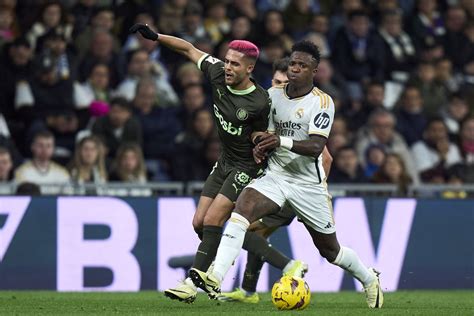
The asymmetry was critical: Vini and Mendy created a powerful left lane, while Vázquez provided width on the right so Rodrygo could attack more central zones. Girona’s right-back Yan Couto was dragged into constant 1v1s and 1v2s he never solved. [5][3] The Guardian+1
Build-up & Pressing
With an emergency centre-back pairing, Madrid’s build-up had to be low-risk but progressive:
- Kroos as deep hub: He dropped between or beside the centre-backs to dictate tempo, hitting early diagonals to Vázquez or Rodrygo that bypassed Girona’s first pressing line. [6][3] Managing Madrid+1
- Full-back staggering:
- Mendy rarely bombed on at the same time as Vázquez; instead, he offered secure left-footed outlets and then stepped into midfield once play was consolidated.
- Vázquez advanced earlier to pin Sávio, opening a vertical passing lane for Valverde. [3][6] understat.com+1
Girona’s press aimed to trap Madrid near the touchlines:
- Dovbyk and Portu curved their pressure to screen passes into Kroos.
- Wingers jumped aggressively onto the full-backs once the ball went wide.
But two things undermined Girona’s plan:
- Press-resistance of Madrid’s midfield: Camavinga and Valverde repeatedly dribbled or passed through the first wave, turning what should’ve been high turnovers for Girona into transition moments for Madrid the other way. [6][3] Managing Madrid+1
- Support from Lunin: The keeper acted as a calm extra outfield player, recycling possession under pressure and forcing Girona to either commit more bodies or drop off. [3][4] understat.com+1
The result was a relatively high PPDA for Madrid (30.2), reflecting their choice to control space rather than chase the ball, versus Girona’s more intense yet ineffective press (21.0). [3] understat.com
Progression & Creation
This is where Real Madrid vs Girona tactics became a showcase for Vinícius and Bellingham.
1. Vini vs Couto: the decisive duel
- The opener comes from Vini receiving in the left half-space, cutting inside onto his right and ripping a long-range shot into the far corner on just five minutes – a huge psychological blow to Girona’s game plan. [3][5] understat.com+1
- Repeatedly, Madrid engineered 1v1s for Vini against Couto by circulating calmly first, then firing a quick diagonal. Once Vini beat his man, Girona’s back line collapsed toward him, leaving gaps behind. [5][3] The Guardian+1
2. Bellingham as “free 10” and late box runner
- For the second goal, Vini slips an outside-of-the-boot pass through the defensive line; Bellingham arrives from deeper, untracked, to finish. Classic third-man run: Rodrygo’s movement pins the back line, Vini receives in the pocket, Bellingham attacks the space. [3][5] understat.com+1
- For 3–0, Bellingham again arrives from behind the forwards, profiting from Girona’s fixation on Vini’s dribble. [3] understat.com
3. Rodrygo’s inside role
- Rather than hugging the touchline, Rodrygo often drifted into the right half-space, making diagonal runs that dragged centre-backs out and opened the channel for Vázquez. His solo run and finish for the fourth goal is the payoff to this positioning: starting wide, cutting inside through the space Girona’s shaken block leaves. [3][5] understat.com+1
Madrid ended with 3.33 xG from 16 shots, a reflection not just of volume but of repeated high-quality entries into the box, especially from the left. Girona’s 0.18 xG underlines how few meaningful entries they had into Madrid’s penalty area. [3] understat.com
Transitions & Rest-Defense
Given the makeshift defence, Madrid’s rest-defense was arguably the most impressive part of the night.
- In possession, the “rest” structure was effectively 3-2:
- Back three: Mendy–Tchouaméni–Carvajal.
- Screen: Kroos plus one of Camavinga/Valverde, depending on which had stayed rather than joined the attack. [3][6] understat.com+1
- When they lost the ball, Valverde and Camavinga were relentless in collapsing centrally, ensuring Dovbyk never received cleanly between lines. Girona were usually forced into backwards passes or speculative long balls. [6][7] Managing Madrid+1
Girona’s best attacks all season had come from quick vertical transitions and exploiting half-space channels; here, those lanes were completely clogged. They finished with zero shots on target, something you almost never see from a top-two attack in a title race. [2][4] Reuters+1
Adjustments
Ancelotti didn’t need drastic formation changes because the initial plan worked, but there were notable game-state tweaks:
- At 2–0, Madrid briefly dropped their line a few metres, inviting Girona to play in front of them and daring them to break the block.
- After Bellingham’s second and his subsequent ankle issue, Brahim Díaz entered as a more conservative connector, helping Madrid keep the ball and limit direct turnovers. [5][20] The Guardian+1
- Later subs (Fran García, Arda Güler, Joselu) allowed Vini and Rodrygo to rest while preserving vertical threat and maintaining pressing intensity. [3] understat.com
Míchel, for Girona, tried to inject energy with Valery, Torre, Solís and Stuani, but by then the structural battle was lost; his team couldn’t generate central superiority or isolate their wingers the way they had all season. [2][5] Reuters+1
Set-Plays
Set-pieces played a supporting, not starring, role here:
- Offensively, Madrid used crowded near-post routines, with Tchouaméni and Carvajal attacking aerial zones and Bellingham looking for second balls.
- Defensively, they relied on a mostly zonal structure with Tchouaméni as primary aerial stopper. Girona’s delivery was decent, but Madrid’s compactness meant almost all clearances landed with a white shirt in the second line. [3][4] understat.com+1
No goals came directly from corners or free-kicks, but set-plays added to Girona’s frustration: they couldn’t even rely on dead balls to change the momentum.
Standout Individuals
- Vinícius Júnior – The main tactical cheat code. Scored a world-class opener, assisted Bellingham and Rodrygo, and tortured Yan Couto all night. Every Girona adjustment started with “how do we stop Vini?” – and none worked. [2][3][5] Reuters+2understat.com+2
- Jude Bellingham – Two goals with trademark late entries into the box, plus excellent work pressing and tracking Girona’s midfield. His early second-half injury (left ankle) forced a substitution and briefly clouded the night, but the damage was already done. [1][5][20] ESPN.com+2The Guardian+2
- Aurélien Tchouaméni & Dani Carvajal at CB – Reads of the game, line management, and aerial duels were all excellent. They turned a potential crisis into a non-story: Girona barely created anything central. [3][6] understat.com+1
- Toni Kroos – The metronome. His long diagonals and tempo control underpinned Madrid’s calmness in both buildup and game management. [6][3] Managing Madrid+1
- Federico Valverde & Eduardo Camavinga – The legs of the system; their ability to press, cover full-backs, and then surge forward in possession allowed Madrid to play aggressively without exposing the makeshift defence. [6][7] Managing Madrid+1
What It Means
From a tactical identity standpoint, this Real Madrid vs Girona tactics battle is a template game:
- Shows Ancelotti’s willingness to prioritize defensive solidity via structure, not just individuals – even with no centre-backs, Madrid produced maybe their most controlled league performance of the season. [6][5] Managing Madrid+1
- Confirms that Vinícius–Bellingham–Rodrygo can carry the scoring and creation load in high-stakes matches without a traditional No.9. [2][1] Reuters+1
- Psychologically, it reasserted hierarchy: Girona’s Cinderella run met peak Bernabéu intensity and couldn’t cope, effectively ending any realistic title push from the Catalan side. [2][5] Reuters+1
For future clashes with Girona (and similar possession-heavy sides), expect Madrid to revisit this blueprint: mid-block, central overload, ruthless transitions through Vini and Bellingham’s late entries – and a gamble that their attacking quality will outstrip any structural risks.
FAQs
Why did Ancelotti use Tchouaméni and Carvajal at centre-back?
Injury absences left Madrid without their usual centre-backs, so Ancelotti turned to Tchouaméni (for aerial presence and ball progression) and Carvajal (for experience and leadership). The structure in front of them – especially Kroos dropping and the Valverde–Camavinga coverage – protected that pairing so well that Girona generated just 0.18 xG and no shots on target. [3][6] understat.com+1
How did Madrid stop Girona’s normally dangerous attack?
Madrid compacted the centre: Kroos, Valverde and Camavinga narrowed passing lanes into Aleix García and Portu, while the back line held a disciplined mid-block rather than over-pressing. That forced Girona wide, where Vázquez and Mendy handled crosses and Lunin was rarely threatened. Girona finished with only five shots, all low quality. [2][3][4] Reuters+2understat.com+2
Was Vinícius or Bellingham more important tactically?
Vinícius was the main destabiliser—every time he faced Yan Couto 1v1, Girona’s structure bent. Bellingham was the primary beneficiary, timing runs into the lanes that Vini’s dribbles opened. You can’t separate them: Vini broke the block, Bellingham punished the gaps. [2][3][5] Reuters+2understat.com+2
How serious was Bellingham’s injury from this match?
He left early in the second half with a left ankle issue after scoring twice. Reports immediately after the game described it as a sprain with expectation he’d miss the midweek Leipzig tie, but not as a long-term concern. [5][20] The Guardian+1
References
[1] ESPN – “Real Madrid 4–0 Girona: Game Analysis & Report”, 10 Feb 2024. ESPN.com
[2] Reuters – “Bellingham scores twice as Real Madrid crush Girona 4–0”, 10 Feb 2024. Reuters
[3] Understat – “Real Madrid 4–0 Girona, La Liga 2023–24 xG & stats”. understat.com
[4] FootballCritic – “Real Madrid vs Girona: Match statistics”. FootballCritic
[5] The Guardian – “Real Madrid 4–0 Girona: La Liga – as it happened”, 10 Feb 2024. The Guardian
[6] Managing Madrid – “Data Review: Ancelotti finds a way vs Girona”, 11 Feb 2024. Managing Madrid
[7] Rattibha – Tactical thread: “How did Ancelotti’s Real Madrid trash Míchel’s Girona?”, 2024. Rattibha
[8] Goal – “Jude Bellingham sends upbeat message after brace vs Girona despite ankle issue”, 11 Feb 2024. Goal




More Stories
Vinícius scores, Brahim creates: Real Madrid stars deliver early at the World Cup
Sevilla vs Real Madrid: Vinicius seals narrow win as Mbappe returns to the XI
Real Madrid lineup vs Sevilla confirmed as Mbappe returns for final away game