Dek
A narrow defeat at Anfield. Here’s how Liverpool’s pressing structure, set-piece design, and Madrid’s transition misfires produced a 1–0 league-phase result—and what Xabi Alonso can fix next time. [1][2][3][4]
Key Tactical Takeaways
- Liverpool won 1–0 (Mac Allister 61’) from a rehearsed set-play pattern after a mid-block first hour; Madrid’s response lacked incision. [2][3][4]
- Under the lights, pressing height ebbed and flowed; Liverpool throttled triggers after the break, while Madrid’s build-up rarely accessed the pivot free. [4]
- Shot quality gap: Opta-powered metrics show xG ~2.6–0.45 to Liverpool, despite Madrid having 61% possession—territory ≠ threat. [3]
- Madrid’s best route (diagonals into the FB–CB channel for Vinícius/Mbappé) flashed but didn’t connect often enough; rest-defense traps from Liverpool closed the outlets. [4][3]
- The night turned on set-pieces and second balls; Madrid conceded the decisive header and couldn’t generate equivalent dead-ball pressure. [2][3]
Tactical Essentials
- Base shapes:
- Liverpool: 4-2-3-1 → 4-4-2 mid-block without the ball; full-backs staggered. [4]
- Real Madrid: 4-3-3/4-1-4-1 in possession with a single pivot and wide wingers held high. [1][3]
- Notable match-ups: Vinícius vs. Liverpool’s right-back channel; Mbappé vs. the near-side center-back; Madrid midfield vs. set pressing traps. [4]
- Key subs & timing: Goal 61’ (Mac Allister header, Szoboszlai delivery). Late cameo for Trent Alexander-Arnold for Madrid; Liverpool introduced fresh legs to protect the lead. [4][3]
- Set-piece notes: Liverpool’s winning routine came from a targeted free-kick—near-post movement drawing markers, late runner into the central lane. [2]
- Metrics (Opta/FotMob): Liverpool 39% possession, xG 2.58 vs 0.45 Madrid; shots 17–8; big chances 4–1. [3]
Analysis & Tactics — Deep Dive
Shapes & Roles
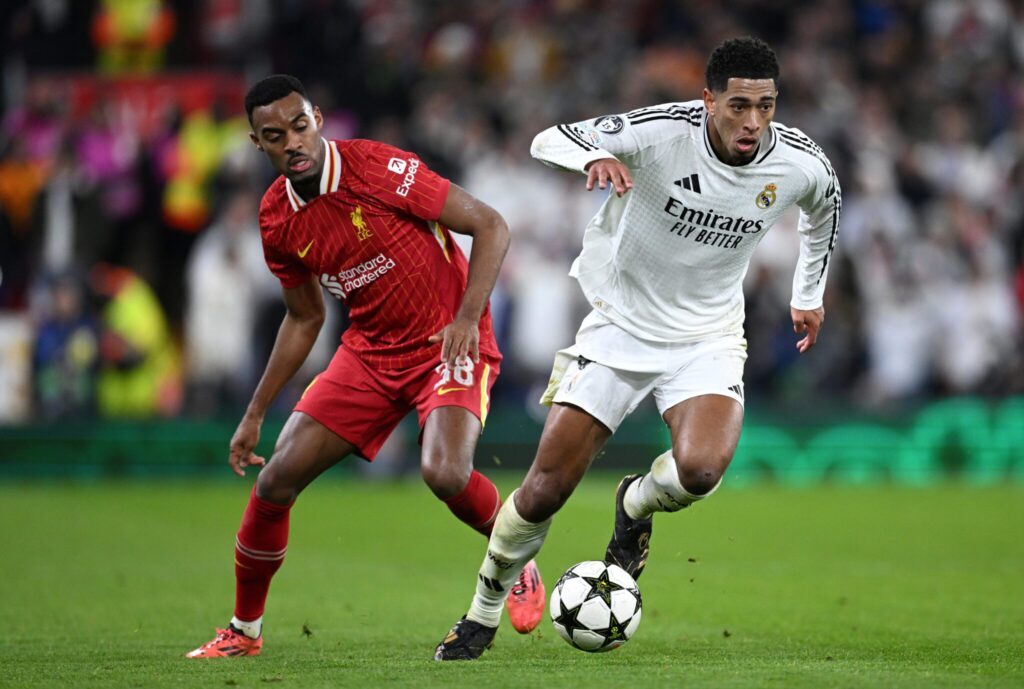
Alonso’s Madrid built in a 4-1-4-1 with the pivot screening second balls and the interiors (including Bellingham) tasked with occupying half-spaces. The wingers (Vinícius and Mbappé) stayed high and wide to stretch Liverpool’s back line and keep the counter threat alive. Liverpool alternated between a 4-2-3-1 press and a 4-4-2 mid-block, with the No.10 stepping alongside the striker to take away Madrid’s first vertical into the pivot. The effect: Madrid held the ball but too often in harmless lanes. [1][3][4]
Build-up & Pressing
Madrid’s build-up. Alonso sought to bait the press to one side and flip diagonally. But Liverpool’s first line curved runs to block access into the 6, while the near-side winger pressed the CB’s outside shoulder. When Madrid did find the pivot, the next pass was frequently horizontal rather than vertical, allowing Liverpool to reset their block. [4]
Liverpool’s evolution after HT. The home side raised their pressing in mini-waves around minute 50–65, compressing Madrid near the touchline and forcing rushed clearances. That period framed the decisive moments: territory, fouls conceded, then a dead-ball in prime crossing range—the phase that delivered 1–0. [4][2]
Progression & Creation
Madrid’s left-side plan—short-short-long to spring Vinícius—surfaced a few times, but the final diagonal never quite arrived in stride. On the right, Mbappé’s starting positions were high against the full-back; without a consistent third-man link from the right interior, his touches came with a defender set. When Madrid did reach the final third, box occupation lagged: wide 1v1s ended with low-probability shots instead of cut-backs to the penalty spot. The shot map tells the story: more Madrid possession, lower xG. [3][4]
Liverpool’s chance creation leaned on arrivals from the second line and deliveries after regains, rather than patient box play. Crucially, their set-piece execution—screens, blockers, and a late central run—produced the winner (Mac Allister header, Szoboszlai assist). [2][3]
Transitions & Rest-Defense
This was the Madrid route back in—win, turn, release. But Liverpool’s rest-defense (two CBs + a holding mid positioned to collapse the centre) smothered the first pass after Madrid losses. When Madrid tried to fast-track Mbappé into the channel, cover defenders delayed just enough for the nearest midfielder to recover. Liverpool’s counter-press reactions in the second half were faster; Madrid’s outlets often received with back to goal. [3][4]
Adjustments
- Alonso’s tweaks: He introduced pace and ball-progression from the bench late, and Alexander-Arnold appeared to add switching range and crossing threat from deeper areas. The structural change marginally improved field position but did not flip chance quality, as Liverpool protected the half-spaces and defended the box with numbers. [4][3]
- Liverpool’s game-state management: After 1–0, Liverpool dropped five to seven metres, prioritized compactness, and targeted set-piece/transition after clearances. Time-management and touchline control were composed. [4]
Set-Plays
Liverpool worked a choreographed free-kick—traffic at the near post, a blocker screen, and a delayed central run from Mac Allister. Madrid’s line hesitated between holding a high zone and tracking movement; the freeze frame shows a free runner attacking central space. Madrid’s own corners lacked second-phase structure—few box-edge shooters and limited screens for back-post routes. [2][3]
Standout Individuals (Madrid focus)
- Thibaut Courtois — strong shot-stopping kept the deficit narrow; distribution under pressure was safe but conservative. [4]
- Jude Bellingham — carried progression in pockets, but final-third connections were starved once Liverpool collapsed central lanes. [4]
- Vinícius Júnior — threatened when isolated, yet support runs were one beat late, turning promising positions into blocked shots. [4][3]
What It Means (for Madrid)
- Signal: Against elite press/set-piece sides away, Madrid can still dominate the ball but must raise chance quality.
- To fix fast: (1) rehearse third-man links on the right to feed Mbappé on the move; (2) add a weak-side box runner arriving at the penalty spot; (3) dead-ball aggression—screens/blockers to free a back-post target.
- Table math: It’s a small setback in the league-phase calculus, recoverable with home efficiency. Opta’s pre-match model rated this close to a coin-flip; that remains the reality among the top seeds. [1][5]
FAQs
Who scored and how?
Alexis Mac Allister headed in a Dominik Szoboszlai free-kick at 61’. [2][3]
What do the numbers say?
Liverpool edged quality: xG 2.58–0.45, shots 17–8, big chances 4–1; Madrid had 61% possession but limited penalty-area touches. [3]
Did Madrid change shape late?
Yes—fresh legs and Alexander-Arnold introduced late to boost switches and delivery, but Liverpool’s block held. [4][3]
Where can I see official line-ups and the event timeline?
UEFA’s match center hosts the canonical line-ups and timeline. [1]
References
[1] UEFA — Liverpool vs Real Madrid: Match Center (official line-ups, events).
[2] Liverpool FC — “Mac Allister wins it as Liverpool defeat Real Madrid” (match report).
[3] FotMob (Opta) — Liverpool 1–0 Real Madrid: stats, xG (2.58–0.45), shots 17–8, possession 39–61.
[4] The Guardian — Liverpool 1–0 Real Madrid: live reaction & report (Anfield).
[5] Opta Analyst — Pre-match probabilities & context.




More Stories
Real Madrid TV penalty controversy grows after 245 replays of Betis handball appeal
Alvaro Arbeloa refereeing rant adds to Real Madrid frustration after Betis draw
Real Madrid title hopes take major hit after late Real Betis collapse