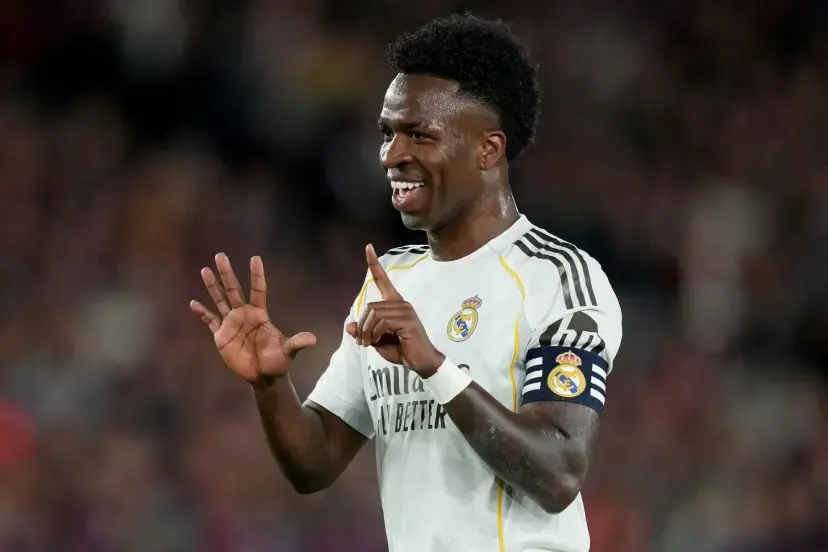
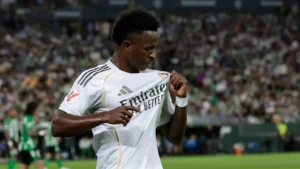
The Vinicius Camp Nou gesture ended up saying more than Real Madrid’s football did. With Barcelona closing in on the La Liga title and then finishing the job in a 2-0 Clasico win, Vinicius turned toward the stands and flashed a “15” with his hands, a pointed reminder that Real Madrid still own 15 European Cups. That was the core of the source story, and it instantly became one of the defining images of the night.
It was defiant, emotional, and completely in line with the way this rivalry works when the scoreline is not enough to contain the tension. Barcelona had the result, the title, and the stadium. Vinicius answered with history. For Real Madrid fans, that made the moment impossible to ignore even in a game that quickly slipped away.
What the Vinicius Camp Nou gesture meant
The message behind the Vinicius Camp Nou gesture was not subtle. According to reports surrounding the moment, the Brazilian responded directly to the home crowd by showing the number 15, referring to Real Madrid’s European Cup haul. Cadena SER reported that he did it more than once during his exchanges with the Camp Nou crowd, while Real Madrid’s official site lists those 15 European Cups as the club’s signature achievement.
That is why the gesture lands as more than a piece of trolling. Real Madrid do not measure themselves only by league tables or one-off Clasico results. They measure themselves by scale, legacy, and the idea that no club in Europe has matched what they have done. Vinicius leaned into that identity in the middle of a night that belonged to Barcelona on the field. It was a reminder that in this rivalry, players are always playing two matches at once: the one on the scoreboard and the one over status.
How the moment unfolded in a title-clinching Clasico
The sporting context matters because it made the gesture sharper. Barcelona entered the match needing only a draw to secure back-to-back league titles, then took control with early goals from Marcus Rashford and Ferran Torres. By the end, Barcelona were champions, and Real Madrid were left watching a rival celebrate at Camp Nou.
That backdrop helps explain why every reaction felt amplified. Vinicius was one of Madrid’s few visible outlets, but the overall attacking display never really settled. Cadena SER described his involvement as limited, though it also noted he had one of Madrid’s clearest moments when a Jude Bellingham pass left him in on goal before Eric Garcia recovered to stop the chance. Even then, the larger story around him became the exchange with the crowd rather than anything he managed to turn into a goal.
And the crowd did not let the moment pass quietly. Cadena SER reported that, late in the game, Barcelona supporters mocked Vinicius with beach balls, one of which even made its way onto the pitch, a clear nod to the Ballon d’Or taunts that have followed him before. So while Vinicius used the “15” sign to talk about European history, the home crowd answered with its own brand of symbolism. That back-and-forth is exactly why this rivalry stays so combustible.
Why this matters for Real Madrid
From a Real Madrid perspective, the obvious reading is frustration. Vinicius did not score, Madrid did not turn the match, and Barcelona walked away with the title. But there is another reading that matters more for a Madrid audience: even when the team is losing, Vinicius still sees himself as the carrier of the club’s attitude in hostile stadiums. He was not trying to change the score with that gesture. He was trying to make sure the night did not belong entirely to Barcelona.
That cuts both ways, of course. Real Madrid need more than gestures in games like this. They need cleaner attacking structure, more authority in possession, and more production in the moments that actually decide Clasicos. Yet it also says something about Vinicius’ place inside the squad. When emotions rise, he is still the player who becomes the center of the story, for better or worse. That matters because Madrid’s next phase will depend not just on talent, but on who sets the competitive tone in nights like this.
What this means for Real Madrid
The biggest takeaway for Madridistas is that this was a symbolic moment inside a very real sporting problem. Barcelona were good enough to win the match and the title. Real Madrid were left reaching for pride, history, and resistance. The Vinicius Camp Nou gesture gave fans a flash of all three, but it also underlined how far the team was from taking control of the occasion itself.
It also opens up several wider conversations that feel worth following closely over the coming days: how Madrid respond emotionally after a public setback, whether Vinicius is being asked to carry too much of the rivalry edge on his own, and how the squad has to evolve before the next major meeting with Barcelona. Those are the kinds of themes that naturally lead into deeper discussion around player roles, attacking balance, and the club’s next big decisions.
What happens next
Barcelona got the trophy moment, but Real Madrid will not see this as the end of the conversation. They rarely do. The Vinicius Camp Nou gesture will linger because it captured something essential about the club: even in defeat, Madrid players reach for the biggest historical argument they have. That does not erase a painful Clasico result, but it does show how this rivalry keeps spilling beyond the final whistle.
Sources Used:
- MARCA(https://www.marca.com/futbol/real-madrid/2026/05/10/vinicius-le-recordo-camp-nou-15-copas-europa-real-madrid.html)
- Cadena SER(https://cadenaser.com/nacional/2026/05/10/vinicius-le-recuerda-las-quince-champions-a-la-grada-del-camp-nou-a-pesar-del-2-0-en-el-clasico-cadena-ser/)
- The Guardian(https://www.theguardian.com/football/live/2026/may/10/barcelona-v-real-madrid-la-liga-title-on-the-line-in-clasico-live)
- Al Jazeera(https://www.aljazeera.com/sports/liveblog/2026/5/10/live-barcelona-vs-real-madrid-el-clasico-la-liga)
- Real Madrid(https://www.realmadrid.com/)
More Stories
Vinícius scores, Brahim creates: Real Madrid stars deliver early at the World Cup
Sevilla vs Real Madrid: Vinicius seals narrow win as Mbappe returns to the XI
Real Madrid lineup vs Sevilla confirmed as Mbappe returns for final away game