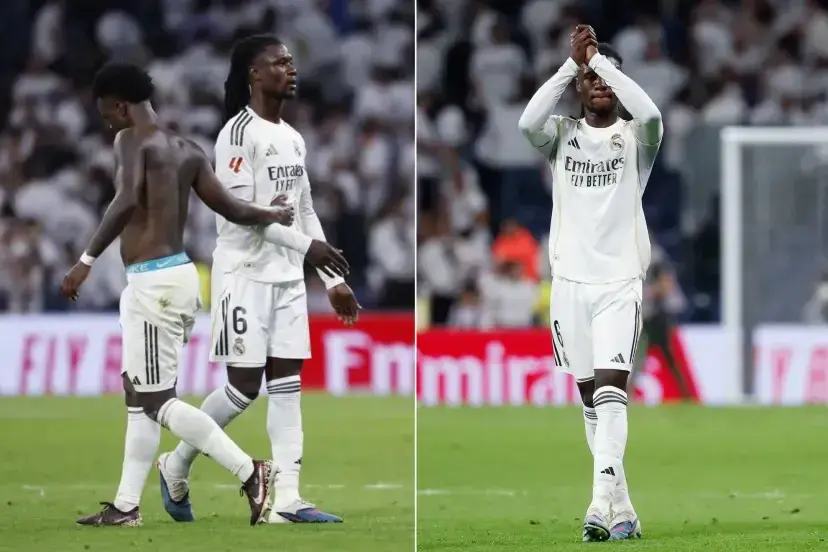
Eduardo Camavinga criticism is no longer just an online debate or a post-match talking point. It reached the Bernabeu on Tuesday night, where sections of the crowd jeered the midfielder before and during Real Madrid’s 2-1 win over Alavés, only days after his sending-off against Bayern Munich became one of the defining moments of the club’s Champions League exit. AP reported that Camavinga was targeted by some home fans, while the win itself ended a four-match winless run and kept Madrid six points behind Barcelona in LaLiga.
That is why this story matters to Madridistas. Camavinga is not a fringe player trying to survive one bad night. Real Madrid’s official site noted after the Alavés match that he had just reached 150 wins for the club in 218 appearances across five seasons, a reminder of how much trust and success have already been attached to his name. That makes the current backlash feel sharper, because it is aimed at a player who has already done plenty for the badge.
Why Eduardo Camavinga criticism has escalated
The obvious trigger is Munich. After Real Madrid’s quarterfinal exit to Bayern, Arbeloa said the tie “ended” with Camavinga’s sending-off and called the decision inexplicable and unfair, making it clear the club felt the moment changed everything. Reuters, in its post-elimination analysis, described the defeat as another blow in a season that had already left Madrid facing the possibility of finishing without silverware. In that environment, individual errors were always going to be magnified.
That helps explain why the reaction against Alavés felt so loaded. AP reported that the Bernabeu was already anxious during a slow start, with parts of the crowd jeering the team as a whole, but Camavinga was one of the players singled out. This was not just about one substitution or one misplaced pass. It was the public release of frustration after a rough week in which Madrid’s European hopes collapsed and the league race looked close to slipping away as well.
There is also a bigger Real Madrid truth underneath it. At this club, scrutiny arrives fast and often without much patience. Arbeloa acknowledged as much in his post-match press conference, saying the demands of the stadium are constant and that supporters want to bring the best out of their players. That may sound like a standard line, but it fits the moment exactly: Camavinga is being judged not only for what went wrong in Munich, but for whether he still looks like a player who can be trusted in the biggest moments.
Arbeloa moved quickly to protect Camavinga
What stood out after the Alavés match was how clearly Arbeloa backed the midfielder. The coach said Camavinga returned to the field, helped the team, and showed the personality expected of him. He added that the player has the trust of his coach, the trust of the club, and, in his view, the trust of the fans as well. That is not a casual defense. It sounded like a deliberate attempt to stop one difficult stretch from turning into a wider narrative about Camavinga’s place in the squad.
That backing matters because the coach is trying to calm two problems at once. The first is obvious: Madrid still need results. Reuters reported that goals from Kylian Mbappé and Vinicius Jr. were enough to beat Alavés and end the slump, but the result still left the team chasing Barcelona with little margin for error. The second problem is emotional. Madrid cannot afford to let one of their key midfielders get swallowed by the atmosphere in the middle of a tense run-in.
Arbeloa’s language also reflected Camavinga’s standing inside the squad. Real Madrid’s official match coverage around the milestone win underlined that he is already a player with 11 titles at the club despite still being young. That does not excuse mistakes, and nobody at Madrid is likely to pretend otherwise, but it does explain why the internal instinct appears to be protection rather than panic. The club knows exactly what Camavinga has already been for them, even if the last few days have badly damaged the mood around him.
The Alavés game showed both the problem and the opportunity
In one sense, Tuesday was a punishment. Camavinga had to walk back into the Bernabeu carrying the emotional fallout from Munich and listen to the reaction in real time. In another sense, it was a chance. The match gave him minutes, gave Madrid a win, and gave the coaching staff an opportunity to publicly reset the conversation before the season drifts any further. AP noted that he was targeted by some fans, but the night still ended with three points, not another collapse.
That does not mean the issue has disappeared. A crowd can forgive quickly at Real Madrid, but it can also return to old frustrations just as fast. That is why this story feels bigger than one evening against Alavés. It is about whether Camavinga can turn the next few games into a response, and whether Madrid can stop the search for scapegoats from overpowering the actual football. That is an editorial inference based on the Bayern fallout, the Bernabeu reaction, and Arbeloa’s public defense of the player.
What this means for Real Madrid
The key takeaway is that Camavinga has become one of the clearest symbols of Madrid’s current tension. He is talented, decorated, still young, and trusted internally, yet he is also carrying the weight of one of the season’s most damaging moments. When those things collide at Real Madrid, the reaction is rarely gentle.
For the club, that creates a challenge that goes beyond one midfielder. Madrid still have to manage the title-race pressure, the emotional comedown from Europe, and the crowd’s impatience all at the same time. Arbeloa said his team has six games left and intends to win them all, regardless of what happens in LaLiga. That message only works if players like Camavinga are still mentally in a place to contribute when called upon.
It also makes the next layer of coverage around the club more interesting. The midfield balance, Vinicius’ own relationship with the crowd, and how Arbeloa manages confidence in a squad under pressure are all now tied together. That is an inference from the coach’s press conference, the Alavés reaction, and Madrid’s position in the table, but it is exactly where Madridistas’ attention is likely to go next.
Eduardo Camavinga criticism has become one of the most revealing subplots of Real Madrid’s run-in. The whistles against Alavés were harsh, but they also made the stakes clear: at this club, reputation helps, yet response matters more. What happens next will say a lot about Camavinga, and just as much about the version of Real Madrid trying to finish this season with some control still intact.
Sources Used:
- Real Madrid
- Reuters
- AP News

More Stories
Yan Diomande Real Madrid Debut Delayed as Mourinho Leaves Winger Out
Ferencvaros vs Real Madrid: Mourinho Starts Endrick as Bernardo Silva Waits
Rodri Real Madrid Transfer Collapses as Barcelona Wins Player’s Choice