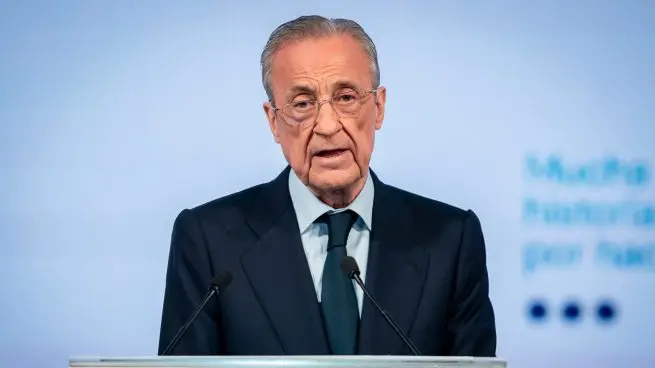
The Florentino Pérez Real Madrid election program has become one of the biggest talking points on a huge day for the club. As members vote in the presidential election, Pérez is not presenting himself as the face of a dramatic reset. Instead, his message is built around continuity, institutional control, more investment, and a promise that Real Madrid can keep growing without giving up its member-owned identity.
That is what makes this story matter beyond campaign slogans. Real Madrid’s Electoral Board officially validated the candidacies of Florentino Pérez and Enrique Riquelme, turning this into a genuine contest, and OKDIARIO’s source report frames Pérez’s platform as a mix of sporting ambition, Bernabéu development, digital expansion, and long-term projects around Valdebebas.
What is in the Florentino Pérez Real Madrid election program?
At its core, Pérez’s platform is about protecting the current model while pushing the club into its next commercial and sporting phase. OKDIARIO says his program backs continuity in the sporting project, new investment in Valdebebas, further technological development around the Santiago Bernabéu, and stronger digital integration with Apple. His official campaign site presents the same idea in broader terms: defend the club’s independence, strengthen the role of the socios, and lead through sporting excellence, innovation, and financial stability.
Continuity, not caution
One of the clearest themes in Pérez’s campaign is that continuity should not be confused with standing still. In his letter to members, he argues that Real Madrid is operating in a football industry shaped by new ownership models, state-backed clubs, global competitions, and fast-changing technology, and that his answer is to keep the club independent while continuing to modernize it. That framing matters because it tells fans he is selling experience and stability as competitive advantages, not just leaning on past trophies.
The official campaign program breaks that vision into several pillars, including institutional protection for the socios, economic independence, sporting leadership, the Bernabéu’s role as a revenue engine, technological innovation, Valdebebas development, the academy, women’s football, basketball, and the club’s social mission. Even without every detail being broken into hard numbers publicly, the direction is clear: Pérez wants to argue that Real Madrid can remain aggressive at the top of world football without changing who owns the club.
Bernabéu and Valdebebas are central to the plan
This is where the platform becomes especially relevant for the club’s next few years. Pérez’s campaign describes the Bernabéu as a strategic asset for the future, not just a stadium, while also presenting “Bernabéu Infinito” as a technology-driven project built around immersive experiences, artificial intelligence, and new ways for supporters to connect with the club from anywhere.
Valdebebas is just as important in the pitch. The campaign site describes an Innovation District around Ciudad Real Madrid focused on knowledge, technology, research, and AI, while OKDIARIO adds that Pérez has also spoken about creating a social club for members and acquiring more land in the area for that purpose. For Madrid fans, that suggests this election is not only about the first team. It is also about infrastructure, long-term assets, and how the club wants to position itself off the field.
The sporting side still grabs the attention
Even so, the sporting angle is always going to dominate headlines around Real Madrid. OKDIARIO says Pérez’s campaign has drawn major attention because of the football promises around the project, including the reported plan for José Mourinho to return as head coach if Pérez is re-elected, plus campaign messaging around signings such as Ibrahima Konaté and Denzel Dumfries and the possibility of another major attacking or midfield addition. Those points should be read as campaign promises reported by the source, not as club-confirmed transfers or appointments.
That distinction matters. Pérez is trying to present a platform that mixes institutional stability with football spectacle, which is a very Real Madrid way of campaigning. The source article makes clear that the sporting package has carried much of the media buzz, but the deeper structure of the program is broader than transfer talk. It is really a pitch for control, scale, and continuity across the whole club.
Why this matters for Real Madrid right now
The timing is what gives the platform real weight. This is not a theoretical roadmap sitting on a campaign website. Members are voting now, and the result will decide whether Pérez gets another mandate to carry out this mix of sporting ambition, commercial expansion, and institutional protection. With the Electoral Board having confirmed only two valid candidacies, every proposal now sits in a sharper, more competitive light.
For supporters, the most important takeaway may be that Pérez is not asking to be judged only on his history. His campaign language is focused on the next decade: monetizing the Bernabéu, expanding the club’s digital reach, developing Valdebebas further, preserving member ownership, and keeping Madrid positioned to attract elite talent. Whether fans agree with every part of that strategy or not, it is a coherent picture of how he sees the club’s future. That is an interpretation based on the platform themes published by his campaign and summarized by the source article.
What this means for Real Madrid
If Pérez wins, the message from this campaign suggests Madrid would double down on the structure already in place rather than pivot into something radically different. Expect the conversation to stay centered on infrastructure, major football decisions, the Bernabéu’s next phase, and how the club balances prestige signings with long-term financial power. If the result is close, that alone will also tell its own story about where member sentiment currently stands. The first point is grounded in Pérez’s platform; the second is a forward-looking inference based on the contested vote.
It also opens the door to wider discussions that Real Madrid readers will keep following closely over the coming days: how any election outcome could affect the coaching picture, squad planning, the club’s transfer posture, academy priorities, and the broader power structure around the Bernabéu and Valdebebas. That is where this story naturally connects to the next wave of coverage across the site.
The Florentino Pérez Real Madrid election program is ultimately a campaign built on a familiar idea: keep the club in the hands of its members, keep Madrid financially strong, and keep aiming bigger on and off the field. Now it is up to the socios to decide whether that vision still feels like the right one for Real Madrid’s next chapter.
Sources Used:
More Stories
Yan Diomande Real Madrid Debut Delayed as Mourinho Leaves Winger Out
Ferencvaros vs Real Madrid: Mourinho Starts Endrick as Bernardo Silva Waits
Rodri Real Madrid Transfer Collapses as Barcelona Wins Player’s Choice