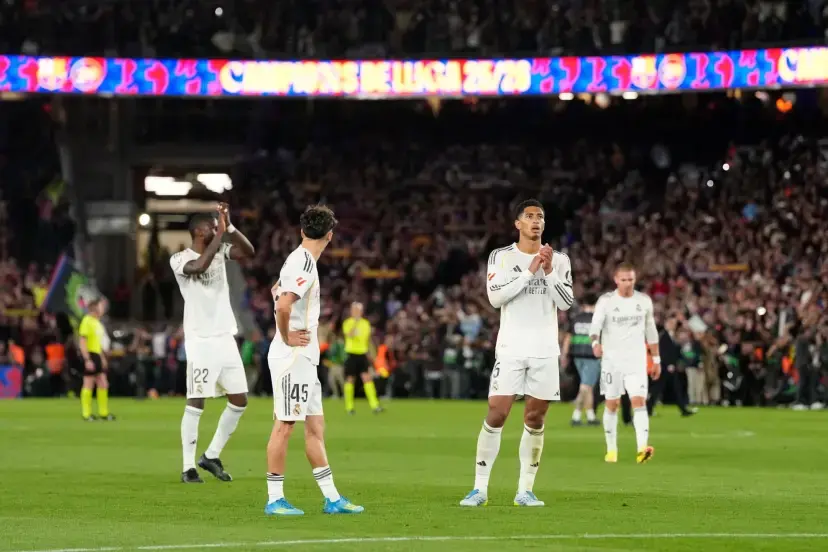
A source piece from MARCA is framing this campaign as seven defining wounds, and that angle lands because it fits what Madrid fans have watched for months: this was not one bad result, but a season that kept reopening the same problems. Mirror listings and promo snippets tied to the MARCA article point to several of the flashpoints it uses, including the 5-2 derby loss at the Metropolitano, Vinicius’ public snub, a November slide, a 0-2 defeat to Celta, a “week of apocalypse” around the Super Cup, Xabi Alonso, and Albacete, plus the whistles heard at the Bernabéu.
That is why the best way to read this story is not as a simple recap, but as a postmortem on a title race Madrid never truly controlled. LaLiga’s table shows Real Madrid in second on 77 points, well behind Barcelona’s 91, while Álvaro Arbeloa has already admitted the league “slipped away” last Sunday and said he understands the frustration and anger around the season.
Why this Real Madrid disappointing LaLiga season feels bigger than one bad run
What MARCA’s framing gets right is the scale of the damage. This has not been a year defined by one tactical mistake or one unlucky month. It has been a season where sporting setbacks, dressing-room tension, injuries, and fan frustration kept stacking on top of each other until the league campaign started to feel broken beyond repair. That reading is supported not only by the source framing but also by the club’s own public tone over the last few weeks.
Arbeloa’s comments have been especially revealing. Before the Oviedo match, he said Madrid must use the final three games to show they deserve to wear the crest and honor it. A coach does not speak that way when the issue is just points dropped. He speaks that way when the season has become a question of standards, identity, and credibility. That is what makes this a genuinely disappointing LaLiga season for Real Madrid rather than a normal runner-up finish.
The derby humiliation set the tone early
One of the clearest wounds in the source framing is the 5-2 defeat at the Metropolitano. LaLiga’s official match log confirms Atlético beat Real Madrid 5-2 in the September derby, while Real Madrid’s own match report described it as the club’s first loss of the season. Even early in the year, that kind of scoreline told Madridistas this team had a much lower defensive ceiling than a title-winning side can usually afford.
The derby mattered beyond the result because it exposed a pattern that kept returning. Real Madrid were good enough to score, talented enough to produce moments, but too unstable to control the game’s emotional and defensive swings. Once that fragility appears in a season, it often comes back at the worst moments. MARCA appears to treat the Metropolitano as one of the first real warning signs, and that feels fair.
The season kept collecting side-stories Madrid could not contain
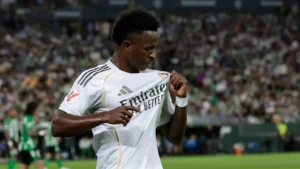
Another reason the league turned sour is that the football never stayed isolated from the noise. Promo snippets tied to the source article reference Vinicius’ “snub,” and even if MARCA’s full text is not fully accessible here, the broader point is easy to understand: Real Madrid spent too much of this season discussing gestures, reactions, and internal turbulence instead of momentum and control.
That same theme runs through the official timeline around Xabi Alonso. Real Madrid announced on January 12 that his time as first-team coach had ended by mutual agreement. On its own, a coaching change is already a major rupture. In the context of a title race, it becomes one more sign that the campaign had slipped into emergency management.
And the cup embarrassment at Albacete only deepened that feeling. Real Madrid’s official report confirms the team were knocked out of the Copa del Rey in the round of 16 after conceding in the 94th minute. That exit is not a league result, but it absolutely shaped the mood around the league season because it strengthened the sense that this team could not protect itself in decisive moments.
Injuries turned a flawed campaign into a draining one
Any honest reading of Real Madrid’s disappointing LaLiga season also has to include the injury crisis. AS reported last month that Madrid had suffered 47 medical incidents, 1,173 total days lost, and 214 missed matches, with 20 players affected and the defense hit hardest. Those are not normal title-race numbers. They are the kind of numbers that deform lineups, chemistry, and rhythm for months.
That does not excuse everything, but it explains a lot. Constant absences make it harder to settle a back line, harder to build automatisms, and harder to sustain intensity across a long campaign. When MARCA talks about wounds, the injuries are not background context. They are one of the central reasons Madrid’s league challenge kept reopening instead of healing.
The “week of apocalypse” captured the collapse
The source’s social snippets also reference a “week of apocalypse” built around the Super Cup, Xabi, and Albacete, and that phrase captures the emotional crash of the season better than almost anything else. Real Madrid’s official site confirms the team lost the Spanish Super Cup final to Barcelona on January 11, then announced Xabi Alonso’s departure on January 12, and then crashed out of the Copa del Rey at Albacete on January 14. In three days, the campaign lost silverware, stability, and public calm.
That stretch matters because seasons are often remembered through compressed disasters. A title challenge can survive one defeat. It can even survive one dressing-room shock. What it usually cannot survive is a cluster of blows that convinces everyone around the club that the ground is moving under their feet. That was the feeling Madrid never fully shook afterward. This is an inference based on the official sequence of events and the source’s own “week of apocalypse” framing.
Bernabéu whistles turned frustration into a public verdict
The final wound is probably the most symbolic one: the crowd. Arbeloa said after the Alavés game that whistles aimed at the team and Vinicius were not new and were part of the Bernabéu’s relentless demand. That matters because once frustration becomes a stadium behavior rather than a debate-show topic, the season has already crossed into something uglier.
Arbeloa tried to frame those whistles as pressure that players must answer with better performances, and that is the right public line. But the existence of those whistles still tells the story. Real Madrid supporters do not usually turn that quickly unless they feel the team is underperforming not just in results, but in authority, personality, and commitment. That is exactly why the Bernabéu reaction belongs in any serious review of this disappointing LaLiga season.
What this means for Real Madrid
The biggest takeaway is that this league campaign was lost in layers. There was the derby damage. There was the coaching rupture. There was the Albacete humiliation. There was the Super Cup loss. There was the injury plague. And then there was the visible breakdown in trust between team and crowd. Put together, those are the kinds of wounds that do not disappear with one summer signing or one optimistic press conference.
That is also why this story naturally opens the door to broader coverage across the site. Every one of these wounds points to a bigger debate Madridistas will keep following: which players still look untouchable, how much the squad needs to change, whether the next coaching cycle can restore order, and which tactical fixes are urgent rather than optional. This was a league failure, but it is also the starting point for the summer.
In the end, the phrase “Real Madrid disappointing LaLiga season” fits because it captures more than just the table. This campaign hurt in episodes, not all at once, and that is exactly why MARCA’s seven-wounds angle works. The challenge now is not only to move on, but to make sure next season does not reopen the same scars.
Sources Used:
- MARCA
- RENOVACIÓN MADRIDISTA
- Real Madrid
- Real Madrid
- LaLiga
- LaLiga
- Real Madrid
- Real Madrid
- Real Madrid
- AS
- Real Madrid
- Real Madrid
More Stories
Yan Diomande Real Madrid Debut Delayed as Mourinho Leaves Winger Out
Ferencvaros vs Real Madrid: Mourinho Starts Endrick as Bernardo Silva Waits
Rodri Real Madrid Transfer Collapses as Barcelona Wins Player’s Choice