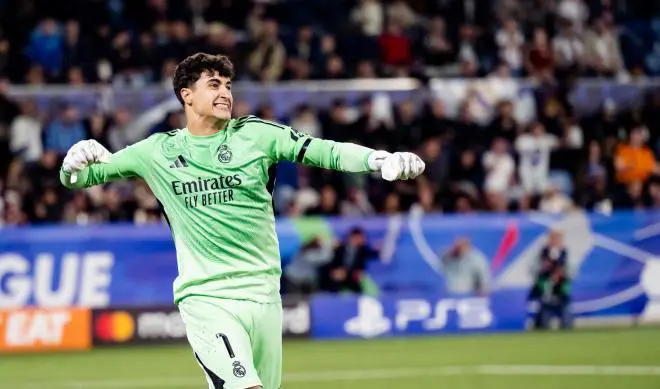
Real Madrid’s latest European celebration did not come from the senior side. It came from Lausanne, where the club’s Juvenil A won the Real Madrid Youth League title after beating Club Brugge 4-2 on penalties following a 1-1 draw in the final. It is the second Youth League crown in club history, and this one had Javi Navarro’s fingerprints all over it.
That is why this feels bigger than a standard academy result. Navarro had already been the penalty-shootout hero against Paris Saint-Germain in the semifinal, and he did it again in the final with two more saves. Real Madrid did not just win a trophy on Monday. They reminded everyone that La Fábrica can still produce teams and players capable of handling European pressure.
The Real Madrid Youth League title was built on control before chaos
For long stretches, Madrid looked like the better team before the match turned messy. Álvaro López’s side started on the front foot, with Daniel Yáñez creating danger early and forcing Club Brugge goalkeeper Argus Vanden Driessche into an important save. The pressure finally paid off in the 23rd minute, when Jesús Fortea’s delivery from the right found Jacobo Ortega, who finished with an outstanding backheel to put Madrid in front. Brugge offered little in the first half, and the scoreline arguably flattered the Belgian side at the break.
That first-half spell mattered because it showed what this team looks like when it plays with confidence. Madrid were aggressive down the flanks, sharp in the final third, and composed enough to keep Brugge from building any real rhythm. Youth finals can quickly become frantic, but Madrid initially controlled the game in a way that suggested they believed they were the stronger side.
Jacobo and Yáñez set the tone
Jacobo will get the headline for the goal, and rightly so, but this final was also shaped by the movement and threat around him. Yáñez was one of Madrid’s most dangerous attacking outlets, while Fortea’s involvement in the opener underlined how important the right side was before halftime. UEFA’s match report also noted that Madrid lost some of that attacking flow after Fortea went off at the break, which helps explain why Brugge were able to grow into the second half.
That detail matters when looking beyond the score. Madrid’s best academy sides usually have more than one standout talent. They have combinations, patterns, and players who can tilt matches in different ways. This group showed that in the final: a striker with instinct, wide players who can create, and a goalkeeper who can decide everything once the margins get tight.
Javi Navarro turned the final into his own story
Club Brugge were always going to react, and they did. After the break, Tian Koren began causing Madrid real problems, and in the 64th minute his run and assist set up Tobias Lund Jensen for the equalizer. Suddenly, the final had changed. The game Madrid had controlled became a test of nerve, concentration, and emotional balance. Navarro then came up with another important intervention when Brugge threatened again, keeping the match alive long enough for penalties.
Once it reached the shootout, the story felt familiar. Navarro saved Brugge’s attempts from Naim Amengai and Koren, while Liberto, Yáñez, Carlos Díez, and Diego Aguado all converted for Madrid. That gave Real Madrid the trophy and confirmed Navarro as the defining figure of the knockout weekend, after he had also saved three penalties in the semifinal win over PSG three days earlier.
Navarro’s own reaction captured the scale of the moment. He said afterward that he still could not quite believe what had happened, while also admitting penalties seem to suit him. It is easy to laugh that off as post-match emotion, but two shootouts in a row say something more serious: Madrid had a goalkeeper who stayed calm when everything around him got loud.
What this means for Real Madrid
The obvious significance is silverware. Madrid are now two-time Youth League winners, and UEFA says they have become only the third club to win the competition more than once, after Barcelona and Chelsea. That alone makes this a major academy achievement, not just a nice one-night story.
The timing gives it extra weight. ESPN’s report, via the Associated Press, pointed out that this title arrived just five days after Real Madrid’s senior side were knocked out of the Champions League quarterfinals. So while the Youth League does not erase first-team frustration, it does offer the club a badly needed reminder that one of its healthiest pipelines is still the academy.
There is also a longer-term message here. After the final, coach Álvaro López praised this generation for its talent and dedication, but he also made it clear that the hard part is still ahead. His point was simple: these players are close to professional football, but getting there will require humility and consistency every day. That is exactly the right way to frame this win. It should be celebrated, but it should also be viewed as a step, not the finish line.
For Real Madrid fans, that makes the next phase especially interesting. Players such as Navarro, Jacobo, Diego Aguado, Joan Martínez, Fortea, and Yáñez have given supporters fresh reasons to follow academy development more closely, especially with bigger questions around first-team depth, squad planning, and who could push upward next. This is the kind of result that naturally sends readers deeper into conversations about Castilla, preseason opportunities, and how many of these names can force their way into the club’s wider plans.
Why this Youth League win should not be dismissed as a youth-only story
One of the easiest mistakes after academy triumphs is to treat them like isolated events. Real Madrid cannot afford to do that. The club’s identity has always been tied to winning Europe, but it is also tied to producing players who understand what that pressure feels like. A final like this gives young players a version of that experience early, and Madrid’s response after conceding the equalizer was arguably the most valuable part of the night.
It also reinforces something supporters are always looking for: signs of the next wave. Not every player from this team will become a first-team regular, and pretending otherwise would be unrealistic. But when a generation wins a European title, keeps its nerve in back-to-back shootouts, and earns this kind of praise from its coach, it deserves real attention rather than polite applause.
The Real Madrid Youth League title may not solve every bigger question around the club, but it has made one thing clear: La Fábrica has produced another group worth watching, and Javi Navarro made sure Europe noticed.
Sources Used:
More Stories
Real Madrid TV penalty controversy grows after 245 replays of Betis handball appeal
Alvaro Arbeloa refereeing rant adds to Real Madrid frustration after Betis draw
Real Madrid title hopes take major hit after late Real Betis collapse